AI Receptionist vs Answering Service: An Honest Comparison
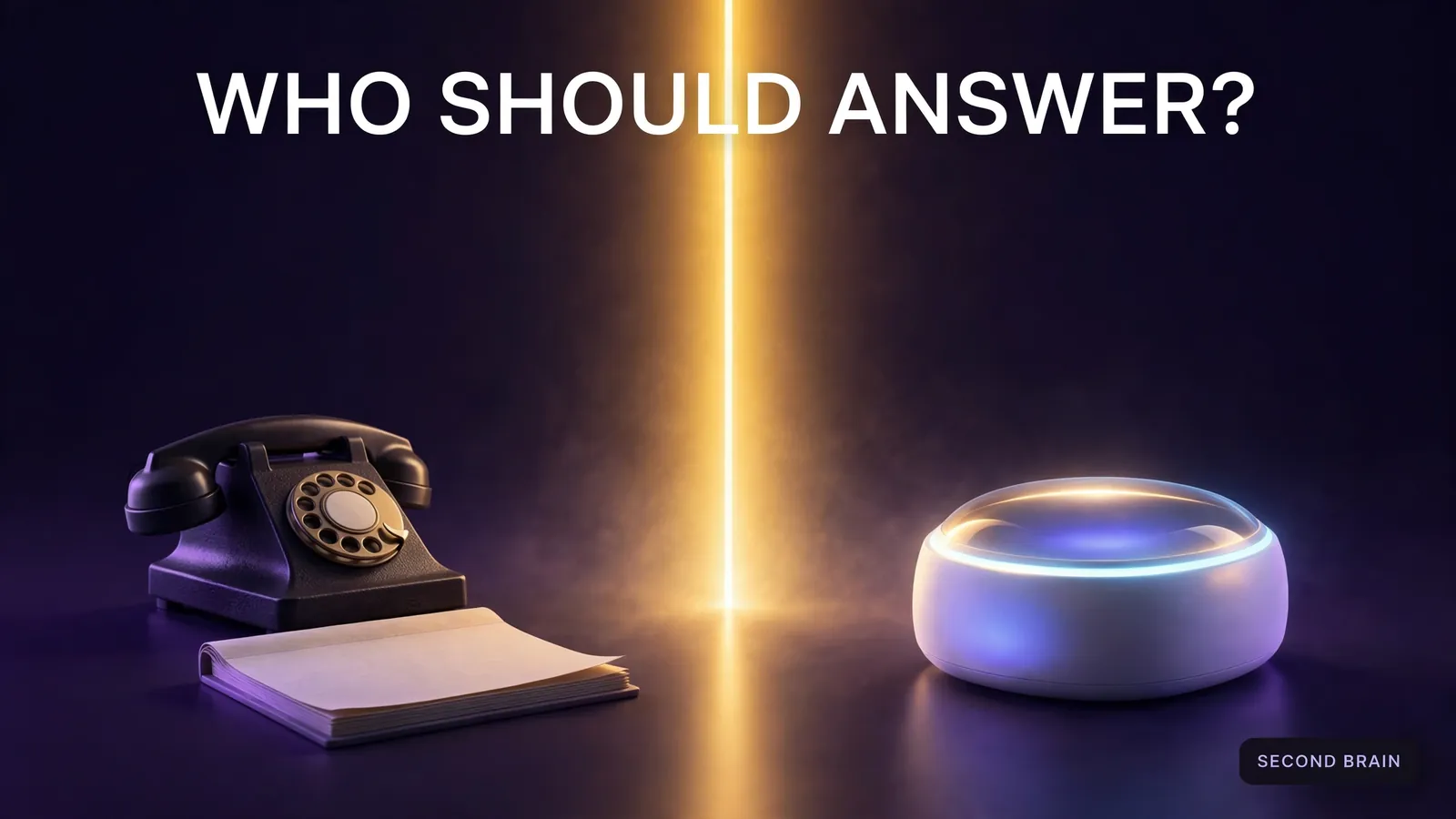
TL;DR: An AI receptionist is built to answer instantly, at any hour, follow the booking rules it was configured with, and write the result straight into your systems. A human answering service brings judgment, warmth, and improvisation to calls that do not follow a script. The right choice depends on your call mix: routine, structured calls favour the AI; emotional, complex, or high-stakes calls favour humans. Many service businesses end up with a deliberate split, and this comparison shows how to draw that line.
Key Takeaways
- Coverage differs in shape, not just hours. An AI is designed to pick up on the first ring with no queue and to handle simultaneous calls, up to the concurrency your plan allows. A human service can cover long hours too, but callers may wait when volume spikes.
- Cost structures differ qualitatively. AI receptionists are typically sold as a subscription, sometimes with usage tiers. Answering services typically charge by time or by call. Judge each against your own call volume and call lengths, using quotes, not headline prices.
- Failure modes are mirror images. The AI fails rigidly: an unusual request, a confused caller, a detail outside its setup. Humans fail variably: a message taken down wrong, a script skipped, a bad day.
- Booking depth is the practical divider. If the job is to check a calendar, offer slots, and confirm, the AI does it inside the call. A message-taking service hands you a note and the booking still waits for your callback.
- Fit beats features. Map your last month of calls into routine and judgment-heavy piles before you shop. The sizes of those piles are the decision.
How does coverage actually compare?
Both options exist to solve the same problem: the call your team cannot take, during a job, after hours, or when every line is busy. The difference is how the coverage behaves under load and at odd moments.
An AI receptionist has no shift and no queue in the usual sense. Within the concurrency limits of the plan you buy, simultaneous callers get picked up at once rather than queued, at 2 p.m. or 2 a.m., in the same tone, with the same questions; beyond those limits, or on a poorly configured setup, callers can wait or land in voicemail like anywhere else. Consistency is its native state, as long as the setup behind it is right.
A human answering service staffs real people across shifts. Good services cover evenings and weekends, but the experience depends on how many other clients' calls arrive at the same moment, and on the individual operator who picks up. The best human coverage feels personal in a way software does not. The worst feels like a message pad with a waiting time attached. When you evaluate a service, you are evaluating its staffing discipline, which you cannot see from the brochure. Ask how they handle simultaneous call spikes and what their answer time commitment actually says.
How do the cost structures compare?
This comparison deliberately quotes no prices, because vendor pricing changes and headline figures hide the shape of the bill. The shapes are stable enough to compare.
- AI receptionist: typically a flat subscription for the platform, sometimes tiered by call volume or minutes, plus whatever implementation help you buy to connect it to your calendar and customer records. Cost is largely predictable month to month, though vendors that price by the minute will charge more for the caller who talked for twenty minutes. Our breakdown of what AI implementation costs shows how setup and subscription lines combine across options like this.
- Answering service: typically charged by the minute, by the call, or in bundled blocks of time, with overage beyond the bundle. Cost tracks your actual call pattern, which means a storm week, a busy season, or a marketing launch shows up directly in the invoice. Long, chatty callers cost more than short ones.
The honest comparison uses your own call log: how many calls, at what hours, of what average length, across a normal month and your busiest month. Give both vendors that same log and compare written quotes against it. A model that looks cheaper on a quiet month can invert completely in your peak season, in either direction.
Where does each one fail?
The AI fails at the edges of its setup. A caller asking something outside the configured knowledge, a distressed or confused caller who needs a person to slow down and think with them, an accent or a bad line that garbles understanding, a request that requires bending a rule for a good reason. Well-built systems escalate these calls to a human or take a structured message rather than improvising. Poorly built ones guess, and a confident wrong answer about pricing, availability, or policy is worse than no answer.
The human service fails at consistency. Operators rotate, so the person answering tonight may know your business less well than the one from last week. Messages get transcribed with errors. Scripts get paraphrased. A caller can reach someone patient and sharp, or someone reading questions in order while the caller tries to explain an emergency. None of this is a reason to avoid human services. It is a reason to test them with mystery calls, review message accuracy weekly, and treat call recordings as the product you are actually buying.
Notice the asymmetry that matters for a service business: AI failures are usually visible in transcripts and fixable in configuration, the same gap for every caller until you close it. Human failures are scattered and harder to pattern-spot, but a good human recovers inside the call itself, which an AI often cannot.
What can each one actually do on a call?
- Take a message. Both, reliably. Judge the message quality, not the promise.
- Book and reschedule appointments. The AI does this natively when connected to your calendar, checking real availability during the call. An answering service can also book when given calendar access and clear rules, and many do. Ask both to demonstrate it, live, with a tricky request.
- Answer routine questions. Hours, service areas, what to expect, how to prepare. The AI answers from its configured knowledge, the same way every time, provided that knowledge was configured correctly and kept current. Humans answer from training and notes, usually well, occasionally creatively.
- Handle judgment calls. A furious customer, a genuine emergency, a caller whose real need is not the one they opened with. Humans win this category plainly, and any honest comparison should say so.
- Feed your systems. The AI writes structured results, bookings, call summaries, contact details, into your records as part of the call. A human service typically delivers messages by email, text, or their own portal, and someone on your team moves the details that matter. Count that labour in the comparison.
There is also a third shape worth naming: a receptionist system built and integrated into your own stack as part of an implementation, rather than bought off the shelf in either form. The comparison criteria in this piece apply to it unchanged: coverage, cost shape, failure modes, fit. What changes is who configures it and how deeply it connects to the rest of your operation.
Which one fits your business?
Draw the line from your call mix, not from preference about technology. Pull a recent month of calls and sort them. Routine and structured (booking, rescheduling, hours, directions, status checks) points to the AI handling first contact well. Emotional, negotiated, or unusual (complaints, complex quotes, distressed callers, anything where the right move is judgment) points to humans. Most service businesses have both piles, which is why hybrid setups are common: the AI takes first contact and handles the routine pile end to end when the call stays inside its configuration, and defined triggers, a complaint, an emergency keyword, a caller asking for a person, pass the call or a priority callback to a human. Whichever shape you choose, measure it the same way you would a speed-to-lead system: answer time, booking rate, and what callers actually experienced, reviewed weekly at first.
FAQ
Do callers know they are talking to an AI?
They should. A well-run setup identifies itself honestly rather than pretending to be a named human employee, both as a matter of trust and because callers adjust usefully when they know: they speak more plainly and ask direct questions. Deceptive setups risk the relationship the call was meant to build. Ask any vendor, of either type, exactly what the caller hears in the first ten seconds.
What happens when the AI cannot answer a question?
In a properly configured system, it does not guess. It says so, captures the caller's details and the question accurately, and routes it for a human callback within a stated window, or transfers live where that is set up. Test this before you buy: call the demo with a question outside the script and watch what it does. That behaviour, not the happy path, is what your callers will judge.
Can an AI receptionist book into my calendar?
Yes, when it is integrated with the calendar you actually run and given your booking rules: services, durations, travel buffers, who can be booked. Without that integration it is a message taker with a voice. Make the vendor demonstrate a real booking, a reschedule, and a double-booking attempt against your rules.
Is an answering service better for a very small business?
Sometimes. If your call volume is low and your calls are mostly judgment-heavy, a good human service can be the simpler fit, with no setup project. If your problem is missed calls at volume, after hours, or slow booking, the AI shape usually fits better. The call log exercise in this piece decides it faster than general advice can.
Sources
- This is a qualitative comparison of two service models. It contains no prices, accuracy figures, or vendor performance claims, because those vary by vendor and change over time. Cost and capability judgements should be made from written quotes against your own call log and from live demonstrations, as the piece describes.
- Companion pieces: how much AI implementation costs for a small business, and the speed-to-lead playbook for the measurement standard any answering system should be held to.