Pet Grooming Review Request System: Asking at Pickup, When the Result Is Visible
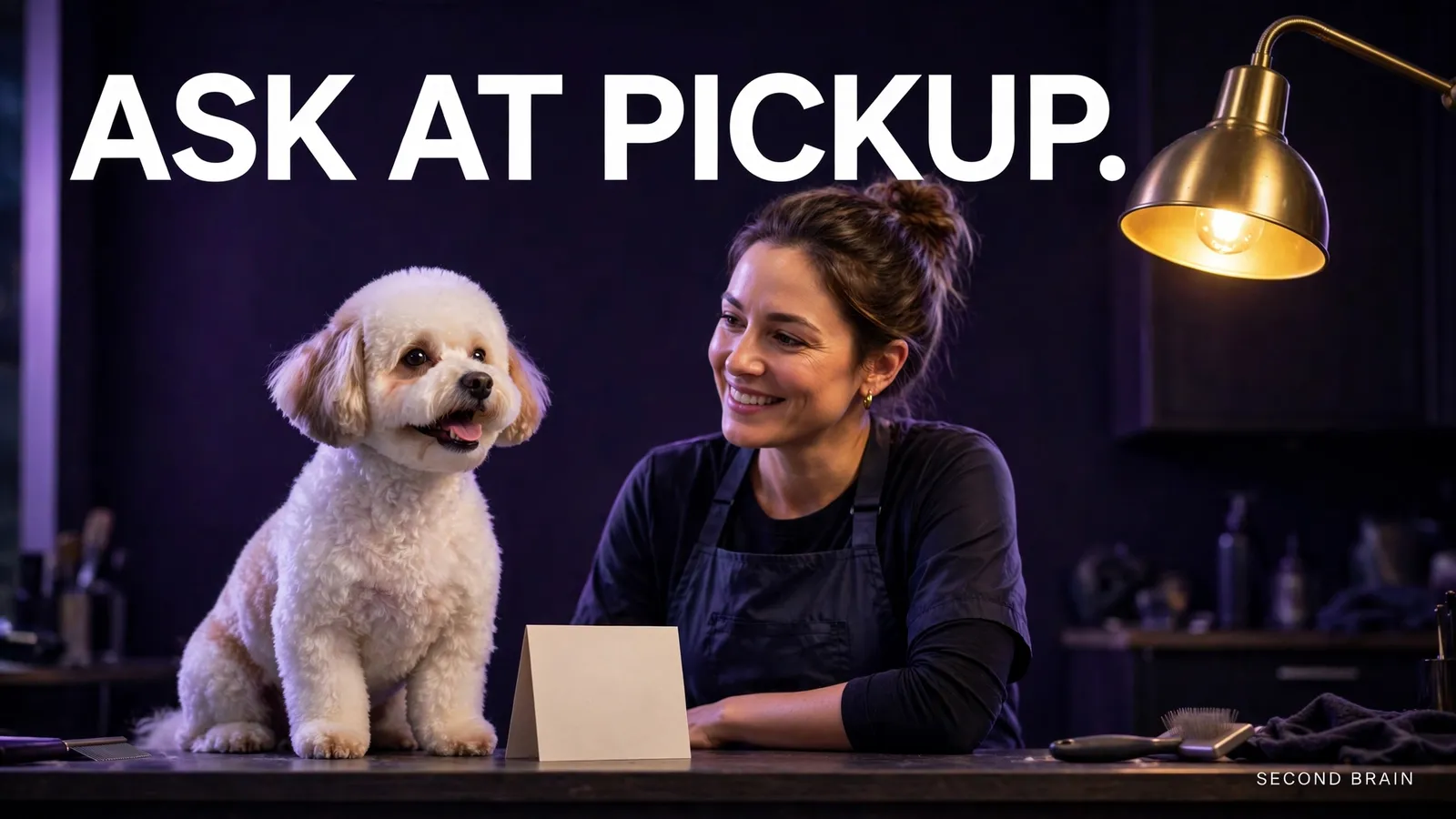
TL;DR: Build the ask into pickup: when the groom is complete and the owner has seen the result, ask every owner on the same even criteria, and make the route one tap through a short link on the appointment card or the booking confirmation message. After pickup, the only second route is one plain invitation in the next booking confirmation, and the ask itself repeats only at the next completed groom, never through repeated messages between visits. Never gate the ask on how pleased an owner seems, never offer a discount, treat, or upgrade in exchange for a review, and never write or steer the wording. Log asks and reviews weekly, so the habit is visible across the whole grooming team.
Key Takeaways
- Templates and systems in this guide are structures, not scripts. The middle of every reply or message is written fresh for the person it answers.
- Ownership matters more than wording: one named role checks the queue daily, so nothing waits on whoever happens to be free.
- Privacy and honesty lines are stated plainly in each section. Do not confirm private details in public, do not invent figures, and do not offer incentives for reviews.
- The monthly read is part of the system. Patterns in reviews, replies, and logs are operations findings, not vanity metrics.
Why groomers collect fewer reviews than their work earns
Grooming is a trust service with a visible result. Owners hand over an animal they love, then judge the cut, the care, and how their pet behaves at handover. Delight at pickup is common, but delight alone rarely becomes a review, because the moment passes in a car park or doorway and the day moves on. The reviews that arrive unprompted skew toward extremes, a transformation photo worth sharing or a matted coat dispute, while the steady middle of good grooms stays silent. A request system corrects that sample, so the profile describes ordinary good work, which is what a new owner choosing a groomer actually needs to see.
Consistency is the second gap. One groomer asks, another feels awkward and never does, and the profile grows with the roster rather than with the quality of the grooms. A system names the moment, the route, and the owner of the habit, so it survives busy Saturdays and staff changes. The policy lines matter as much as the timing. Google prohibits gating and incentives, and a free nail trim traded for five stars puts the profile at risk. The governing rules are in how to ask for Google reviews without breaking the rules, and the mechanics of timed asks are in automated review requests.
The pickup moment, and the rebooking second chance
Pickup is the strongest moment in the service: the owner has just seen the result, the pet is calm and presentable, and the conversation is already warm. The ask belongs there, brief and unpressured, after payment and care notes are done, with the route pointed out on the appointment card or receipt. Do not ask before the owner has seen the pet, and do not ask while a handling concern or a coat problem is being discussed. Those conversations deserve full attention, and an ask inside them reads as deflection.
Rebooking creates a second, quieter route. The booking confirmation for the next groom can carry the same short link with one plain line inviting an honest review of the last visit. That reaches owners who were rushed at pickup, without any chasing messages in between. One ask at pickup and one line in the confirmation is the whole cadence. More than that turns goodwill into pressure, and pressured owners do not write the reviews a groomer wants anyway. The criteria stay even throughout: every owner, every completed groom, whatever their mood at the desk.
Route, wording shape, and team confidence
The route must take under a minute: one short link or code straight to the review form, tested on a phone with the salon wifi and without it. If the link opens a search page or a social profile instead of the form, owners with good intentions will abandon it, and the team will conclude wrongly that owners do not want to review.
Wording is a shape, not a script: thank the owner for trusting the salon with their pet, invite an honest review to help other owners choose, and point to the route. Never suggest stars, never mention a target rating, and never stand over an owner while they write. Photos need separate, explicit permission. A review ask must never be bundled with consent to post a pet picture, because the two decisions are different and owners should feel free to decline either one. New groomers learn the shape by hearing it at real pickups, and managers protect the habit by treating a fair, middling review from a real owner as the system working, not as a team failure.
Reading results and replying well
Keep a weekly log: grooms completed, asks recorded, reviews arrived. No response rate is claimed in this guide, and a salon should build its own picture from its own log over a season rather than borrowing a figure. The log exists to spot patterns. If asks vanish on Saturdays, the issue is desk pressure at peak pickup, and the fix is a second pair of hands at that hour, not a lecture about reviews.
Read the reviews monthly for operations findings: waiting times at drop off, coat advice owners found unclear, booking gaps for large breeds. Reply to every review with calm, specific structures, using the discipline in how to respond to a negative Google review, and never confirm pet health details in a public reply. Second Brain helps grooming businesses run this request discipline with the rest of the reputation system: the pickup ask, the one tap route, reply ownership, and the monthly read that turns reviews into better handovers and clearer coat advice.
FAQ
When exactly should a groomer ask for a review?
At pickup, after the owner has seen the finished groom and payment and care notes are complete. The booking confirmation for the next groom can carry one more plain invitation for owners who were rushed.
Can a salon offer a discount or a free add on for a review?
No. Anything of value offered in exchange for a review is an incentive and breaks platform policy. The ask must stand on its own and use the same even criteria for every owner.
Should the ask include a request to post the pet photo?
No. Photo consent is a separate decision and needs its own explicit permission. Bundling it with a review ask pressures owners and muddles both consents.
What if an owner is unhappy at pickup?
Handle the concern fully and privately first. The system still asks every owner on even criteria through the standard routes, such as the confirmation line, but no ask belongs inside a difficult conversation at the desk.
Sources
- Keyword basis: queue candidate added 2026-11-01 in .saeo/keywords.yaml for this draft. No volume or difficulty figure is claimed in this post.
- Policy framing where reviews are discussed: Google Business Profile review policy, as the governing source for review requests, gating, incentives, reporting, and removal, read in general terms for this guide. Readers should check the current policy text, as Google updates it.
- Internal link targets were checked against slugs existing on disk in this content folder on 2026-11-01.
- No statistics, response rates, or ranking effects are asserted here. Message shapes described are structural illustrations, not verbatim scripts.