Ranking is not enough any more
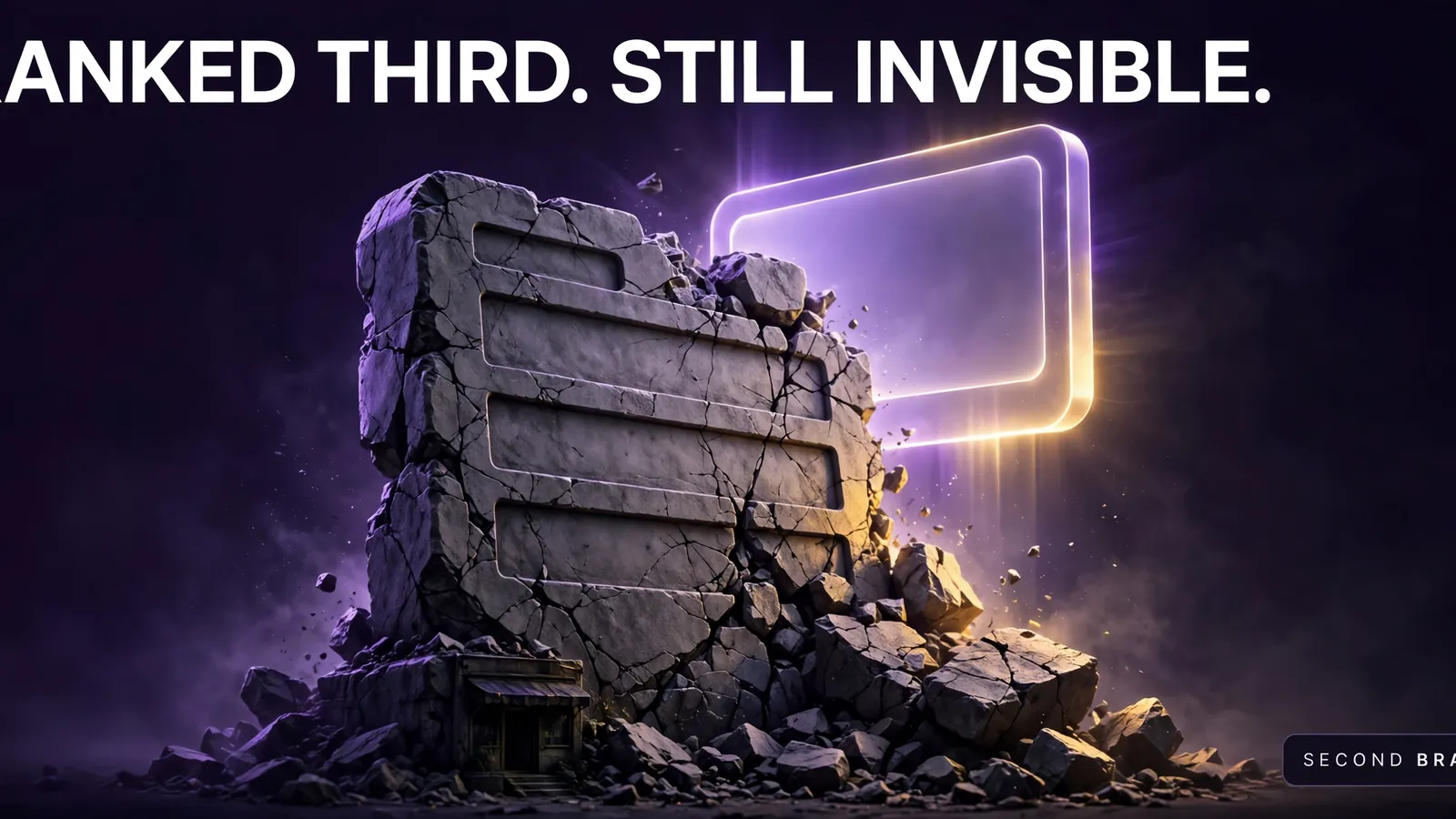
Ranking on Google and getting cited by an AI answer engine are different goals now. Being cited takes a page that states its answer first and makes clear who is behind it, and that is a different job than chasing a ranking.
For twenty years the goal was the same: be one of the ten blue links, ideally near the top. Everything the industry built (keywords, backlinks, meta tags, content calendars) served that one objective.
That objective is quietly becoming a subset of the real one.
Where do people ask their questions instead of Google?
When someone wants a plumber in Toronto, they increasingly do not open Google and scan results. They ask ChatGPT, or Perplexity, or the assistant built into their browser. And the answer that comes back is not ten links. It is a paragraph, with two or three sources named.
You are either in that paragraph or you are invisible. There is no page two to be on.
Does ranking high mean you'll get cited by AI?
Ranking and being cited are different problems, and this is where most people get it wrong: they assume that if you rank well you will be cited well, and the two mostly move together. They do not. A page can win one and still lose the other.
- Ranking rewards authority signals accumulated over time: links, domain age, engagement.
- Citation rewards being the cleanest available answer to the exact question asked, in a form a model can lift without ambiguity.
A page can rank third and never be quoted, because its answer is buried in paragraph nine under a story about the author's childhood. A page can rank eleventh and be quoted constantly, because it answers the question in the first forty words and states its claims plainly enough to be extracted.
The model is not choosing the most popular page. It is choosing the page it can most safely quote.
What actually helps a page get cited by AI?
Three things move it, done in this order. State the claim before explaining it, so the answer sits at the top of the page. Make it obvious who wrote the page and why they can be trusted, since models weigh that heavily. Publish a plain text map of the site so a model can find the canonical answer fast. None of it costs much.
- Structure the answer first. Every page states its claim before it explains it. Question as the heading, answer immediately below, evidence after. This costs nothing and is the single biggest lever.
- Make the entity legible. Who wrote this, what do they do, why would anyone trust them. Models weight this heavily because they are exposed when they quote something wrong.
- Publish
llms.txt. A plain-text map of what your site covers and where the canonical version of each answer lives. Cheap, and still rare enough to be an advantage.
None of that costs you rankings. Pages built to be quoted tend to rank better too, because the things that make an answer extractable (clarity, structure, specificity) are the things readers wanted all along.
Is there a guaranteed way to win AI citations?
This field is about eighteen months old and the ground moves. Anyone selling you a guaranteed method for AI citation is selling you a guess with a price on it. What we do is measurable: we track which answer engines send you traffic, we watch what they quote, and we adjust. That is a discipline, not a formula. The discipline, made concrete: we are running an audit of what ChatGPT recommends across 40 independent service businesses, checking every claim it makes about them, and the visibility pass that audit feeds is priced as part of AI implementation.
The advantage right now is simply that almost nobody is doing it deliberately. That window will close.
Key Takeaways
- Ranking on Google and getting cited by an AI answer engine are different goals, and optimizing for one does not automatically win the other.
- AI assistants like ChatGPT and Perplexity typically answer with a short paragraph naming two or three sources instead of a page of ten links, so there is no page two to fall back on.
- A page earns a citation by stating its answer in the first few sentences and making clear who wrote it, not simply by ranking well.
- Publishing a plain text llms.txt file that maps a site's content is cheap to do and still uncommon enough to count as a real advantage.
- No guaranteed method for winning AI citations exists yet, so tracking what gets quoted and adjusting works better than chasing a fixed formula.
FAQ
What is AEO?
AEO stands for answer engine optimization. It is the practice of structuring a page so that AI systems such as ChatGPT, Perplexity, and Google's AI Overviews can find a clear answer inside it and quote that answer directly. It sits alongside traditional SEO rather than replacing it, since a page still has to be findable before it can be cited.
Should I stop doing SEO and focus only on AI citations?
No. The two goals are complementary rather than competing, because pages built to be quoted also tend to rank well: clarity and structure help a search engine and a model in the same way. Dropping standard SEO practice would cost visibility on the channel that still sends most sites the bulk of their traffic today.
What is llms.txt and do I need one?
llms.txt is a plain text file published at the root of a website that maps out what the site covers and points to the canonical version of each answer. It costs little to create and is still rare enough to count as a real advantage. It will not fix a page that fails to answer its own heading clearly, so it works best alongside the structural changes, not instead of them.
Is there a guaranteed way to get cited by an AI answer engine?
No, and anyone who promises one is selling a guess with a price attached. The practice is young enough that the ground still moves under it. What is realistic is treating it as an ongoing discipline: track which answer engines send traffic, watch what gets quoted, and adjust from there.
Why does it matter who wrote the page?
A model gets exposed when it quotes something wrong, so it weighs the credibility of a source before lifting a claim from it. A page that states plainly who wrote it, what they do, and why they can be trusted is an easier, safer page for a model to quote than an anonymous one making the same claim.