Restaurant Review Request System: Asking at the Right Moment, Every Service
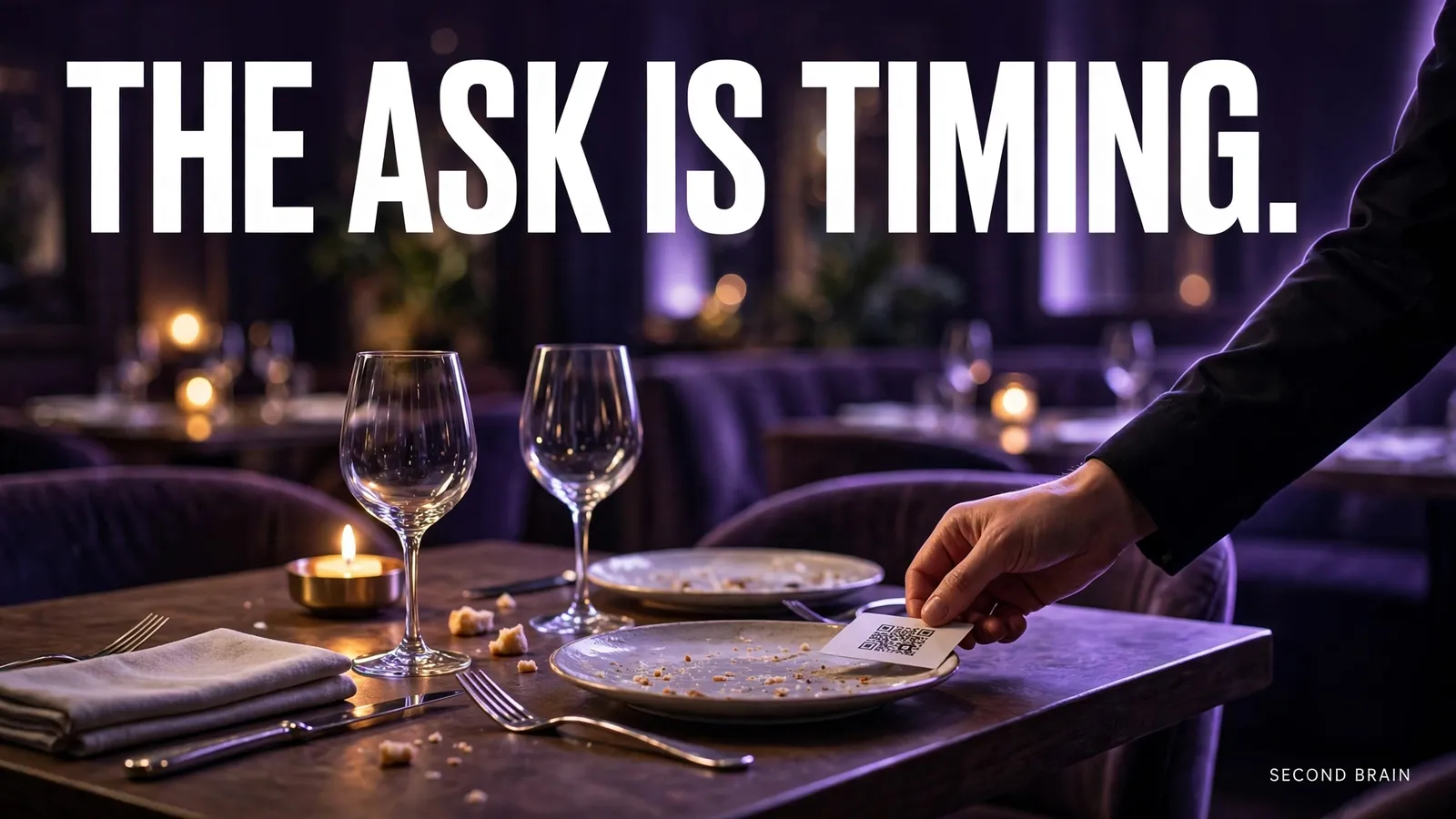
TL;DR: Build the ask into service itself: choose one natural moment, the end of a seated meal or the delivery handover for takeaway, ask every guest who had that experience on the same even criteria, and make the route one tap through a short link or table code. Never gate the ask on how happy a guest seems, never offer a free item or discount in exchange for a review, and never have staff post or steer wording. Log asks and reviews weekly by service, so the pattern shows which shifts run the system and which quietly skip it.
Key Takeaways
- Templates and systems in this guide are structures, not scripts. The middle of every reply or message is written fresh for the person it answers.
- Ownership matters more than wording: one named role checks the queue daily, so nothing waits on whoever happens to be free.
- Privacy and honesty lines are stated plainly in each section. Do not confirm private details in public, do not invent figures, and do not offer incentives for reviews.
- The monthly read is part of the system. Patterns in reviews, replies, and logs are operations findings, not vanity metrics.
Why restaurant reviews depend on a system, not on hope
Guests review at extremes. A celebration meal and a spoiled evening both produce reviews without any prompting, while the large middle of good, ordinary meals produces almost none. That means a profile built on chance alone overrepresents extremes and underrepresents the experience most future guests will actually have. A request system corrects the sample. When the ask becomes a standard step of service, the reviews that arrive describe normal operations, which is both fairer and more persuasive to a reader choosing where to book.
The second problem is inconsistency between shifts. One team asks warmly and often, another never asks, and the profile grows in bursts that track rosters rather than quality. A system names the moment, the owner, and the route, so the ask survives staff changes and busy services. The policy lines are not optional decoration. Google prohibits review gating and incentives, and a restaurant caught trading desserts for five stars risks the reviews and the profile. The full rules sit in how to ask for Google reviews without breaking the rules, and the automation mechanics sit in automated review requests. This piece fits both to restaurant service.
Choosing the moment: seated, takeaway, and events
For seated guests, the natural moment is after the bill is settled and the meal is complete, while the experience is whole and the table is relaxed. The server who looked after the table makes the ask, briefly and without pressure, and points to the route on the bill card or table tent. Asking mid meal interrupts the experience the review is meant to describe, and asking at the door, coats in hand, gives the guest no easy way to act.
For takeaway and delivery, the moment is the handover or the confirmation message after delivery, with the same short link in the box or bag insert. Keep the insert small and plain. A large card begging for five stars reads as anxiety and can cheapen the food it travels with. For private events and large bookings, one ask to the organiser after the event closes the loop, rather than a request sent to every attendee. In every channel the criteria stay even: every guest in that service gets the same ask, whatever their mood at the table. Choosing only smiling tables is gating, even when it feels like common sense.
The route, the wording shape, and staff confidence
The route must take under a minute: one short link or code, straight to the review form, tested on the phones your staff actually carry. Every extra step, a search, a login hunt, a generic homepage, loses guests who meant well. Test the route monthly, because links rot and codes get reprinted wrong.
Wording is a shape, not a script. Thank the guest for coming, name one true specific from their visit only if it comes naturally, state that honest reviews help other guests choose, and point to the route. Staff should never suggest stars, never mention what a review is worth to the business, and never stand over a guest while they write. New staff learn the shape by hearing it in service, not from a laminated paragraph, and managers protect confidence by making clear that a fair three star review from a real guest is a success for the system, not a failure by the server who asked.
Reading the results and keeping the system honest
Review the log weekly by service: how many covers, how many asks the team recorded, and how many reviews arrived. The point is not a conversion figure to chase. No response rate is claimed here, and any restaurant should build its own picture from its own log rather than borrowing one. The point is pattern spotting. If Friday asks vanish, the issue is rota pressure, not guest goodwill, and the fix is operational.
Read the reviews themselves monthly for operations findings: pacing between courses, noise, water and bread basics, booking mix ups. Reply to reviews with the same discipline, using the structures in how to respond to a negative Google review. Second Brain helps restaurants set up this request discipline with the rest of the reputation system: the timed ask, the one tap route, reply ownership, and the monthly read that turns reviews into service fixes instead of a score the team watches with dread.
FAQ
When is the best moment to ask a restaurant guest for a review?
After the meal is complete and the bill is settled, while the whole experience can be judged. For takeaway, at the handover or in the confirmation message after delivery. Mid meal asks interrupt, and doorstep asks give no easy route to act.
Can a restaurant offer a free drink or dessert for a review?
No. Anything of value offered in exchange for a review is an incentive and breaks platform policy, whether or not a positive review is requested. The ask must stand on its own, with the same even criteria for every guest.
Should servers ask only guests who seem happy?
No. Selecting guests by apparent happiness is review gating. Ask every guest in the service on the same criteria. A fair profile built from ordinary meals persuades readers more than a perfect profile built from selected ones.
How should a restaurant handle a review it believes is fake or from a rival?
Reply briefly and factually, without accusation, then report it through the profile if it fits a policy category and accept the platform decision. Do not trade public claims about who wrote it.
Sources
- Keyword basis: queue candidate added 2026-11-01 in .saeo/keywords.yaml for this draft. No volume or difficulty figure is claimed in this post.
- Policy framing where reviews are discussed: Google Business Profile review policy, as the governing source for review requests, gating, incentives, reporting, and removal, read in general terms for this guide. Readers should check the current policy text, as Google updates it.
- Internal link targets were checked against slugs existing on disk in this content folder on 2026-11-01.
- No statistics, response rates, or ranking effects are asserted here. Message shapes described are structural illustrations, not verbatim scripts.